

40 years of WEINMANN - Timber construction then and now
15.09.2026 г.
It all began in 1985. Two fellow students Karl Weinmann and Alfred Schlegel make a decision that requires courage: They started their own company.
The first company headquarters? A simple garage. But what emerged from there is anything but ordinary. Supported by a pioneering spirit, technical ambition and a firm belief in the future of automated production technology, they laid the foundation for a development that was to shape the industry.
SchwörerHaus KG is the first and key partner on this path. The shared history marks not only the beginning of close collaboration, but also the start of a technological breakthrough. Johannes Schwörer (Managing Director SchwörerHaus KG) and Hansbert Ott (former Managing Director WEINMANN) talk together about their shared history and the future of timber construction.
The company's history begins (1985)
Fellow students Karl Weinmann and Alfred Schlegel founded WEINMANN in 1985 and initially produced machines for a range of industries, including gardening – which has no connection to wood.
The beginnings (1987–1992)
A decisive turning point in the company's history follows in 1987: The idea of an automated machine for the production of special pallets, the so-called palletomat, began to take concrete shape. The first prototype is developed and built in the style of great tech legends in Karl Weinmann's garage. The planned removal shows that the machine is now larger than the garage door. So it is quickly dismantled, loaded and delivered to the first customer. By 1993, around 150 pallet machines
had been built, a great success for the startup company. 1992 saw the growth of the management team. Hansbert Ott, another fellow student, joined the company and expanded the management team.
A strong partnership is formed and with it the company's entry into timber construction (1993)
The big breakthrough was achieved in 1993. SchwörerHaus KG takes notice of WEINMANN and commissions the company to develop a wall production line for timber house construction. At that time, this was a big risk, as WEINMANN had no experience in timber house construction. Nevertheless, the three managing directors made a commitment and planned the production line together with SchwörerHaus for 9 months. Ultimately, WEINMANN is successful and received the order. There are only three weeks available for the installation. The task that sounded impossible is a resounding success: After four weeks, the plant is put into operation. This was a milestone and laid the foundation for the success of WEINMANN today. With state-of-the-art CNC technology, intelligent data exchange and consistently automated processes, WEINMANN is taking timber construction to a new level. What emerges from this is far more than an advance - it's a technological quantum leap that is changing the industry in a sustainable way. This machine is still an integral part of SchwörerHaus production. Its robust design and reliable process stability make it possible to manufacture additional houses on it year after year.
ExNorm – A global project (1996)
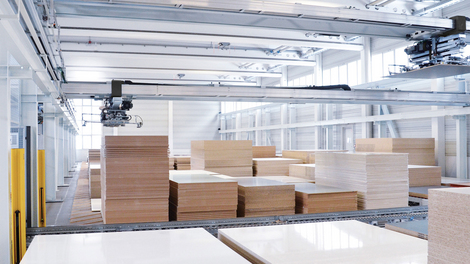
Another flagship project followed in 1996 with ExNorm: A fully automated production process, including cutting, production and loading. The plant becomes an international reference point – serving as a showcase project worldwide.
HOMAG invests in WEINMANN (1998)
In 1998, the HOMAG Group became aware of the company and acquired a 51 percent share of the company. This opened up a global sales network for WEINMANN with branches in more than 65 countries. This is a huge step and a challenge at the same time, as HOMAG has only been active in the furniture industry up to now and first has to acquire knowledge in the field of timber house construction
Growth, hall construction and complete system expertise (2000–2005)
A new production hall complex is built in 2000, and the existing production building is converted into an administrative building. The first standardized carpentry machine is built in 2001. This makes the company the first complete system supplier for the entire timber construction production process, from the control system to mechanics and service. For customers, this means a noticeable increase in comfort. In the event of questions or concerns, a single, reliable contact person is available in a simple, fast and efficient manner. With the support of the HOMAG sales network, WEINMANN is constantly opening up further markets and countries. What began as a continuous expansion finally culminated in a remarkable milestone in 2005: the company's rise to become the global market leader.
New markets, new requirements (2008)
In Russia, 2008 marked the start of a period of intense market activity, albeit one fraught with unforeseen challenges. Instead of experienced timber construction companies, you mostly encounter investors who still have to build up their knowledge from scratch. The solution: WEINMANN accompanies customers
step by step, shares the necessary expertise and helps to make complex timber construction projects possible in the first place. The WEINMANN Academy is born from this challenge. A unique service that accompanies customers throughout all steps of the process. It offers knowledge, orientation and practical support and makes complex processes understandable. This turns theory into real competence.
Financial crisis and change in the market (2010–2013)
The global financial crisis also affects WEINMANN and slows down investment in the timber construction industry.
However, in Germany and neighboring countries in particular, many small and medium-sized businesses are starting to invest despite the uncertainty. WEINMANN responded to this by focusing on products such as the carpentry table and a modular phased program that enables entry-level automation in production and can be expanded as required in the future. In Central Europe, the topic of modular construction gained greater focus in 2013. A concept already established in many parts of the world. However, the German market is not yet ready for this design at this point in time. But demand remains subdued, and it is only years later that modular construction develops into a major trend with growing acceptance and significance.
Robotics, standardization and efficiency leaps (2016–2017)
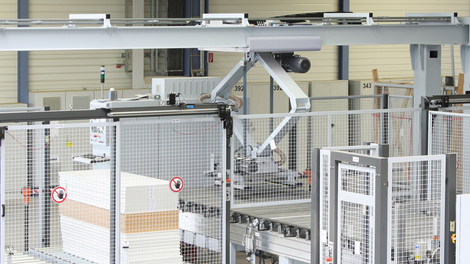
In 2016, robotics was introduced into timber construction. Robots support employees during heavy and repetitive work and enable a high level of ergonomics with consistently high quality. Another important step follows in 2017. A highly standardized generation of machines is created with the aim of reducing half the costs without compromising on performance or quality. A bold project, but one that succeeds. Standardization as the key to cost-effectiveness.
Generation change, major projects and new partnerships (2020–2023)
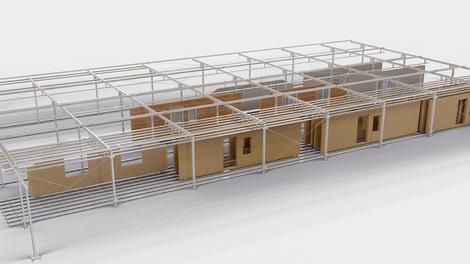
In 2020, Hansbert Ott, the last of the three long-standing managing directors, retires. The shareholders Karl Weinmann, Alfred Schlegel and Hansbert Ott then transferred their shares to the HOMAG Group. Since then, WEINMANN has been 100% part of the corporate group. In 2021, the company received the order for one of the Europe's most ambitious plants. A highly automated gigafactory for the production of components for 20,000 residential units in Magdeburg.Major corporate investment is completed in 2023. WEINMANN acquires a stake in granIT, the leading provider of MES systems – a logical step, as WEIN-MANN has been working on the issue of software with software partner granIT since 1993
Wood in its most beautiful form: The new production hall (2023)
The fourth hall bay is completed in 2023 and is completely made of wood. The warm atmosphere shows that wood is not only the building material of the future, but also creates work rooms of its own quality. A clear statement for sustainability and innovation
40 years of WEINMANN (2025)
To celebrate its 40-year anniversary, WEINMANN can look back on impressive development: From a small garage business to the global market leader. The first major order for SchwörerHaus in the field of timber house construction was a decisive milestone on this path. This was the trigger for a success story that continues to this day and will continue in the future.
An article published in the customer magazine *performance 2026*.