

Modular Platform for True End-to-End Integration
10.11.2026 г.
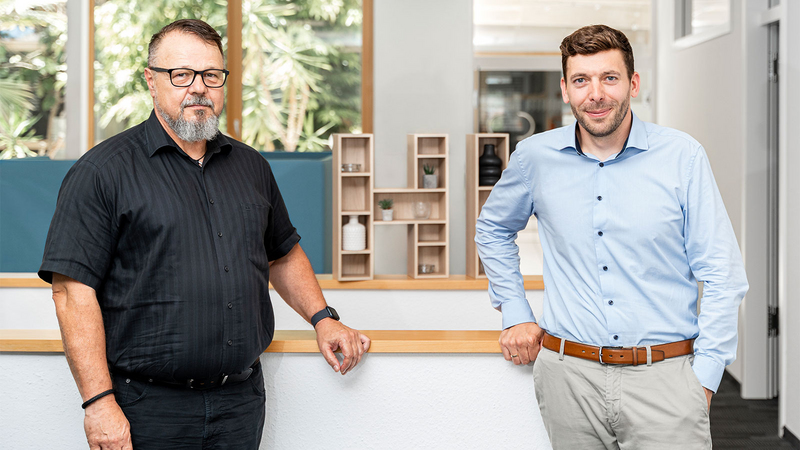
The digitization of woodworking and furniture manufacturing is reaching a new level: With HOMAG INTELLIGENCE, the machinery giant is launching not just traditional software, but a modular, cloud-based platform. In an interview with möbelfertigung Editor-in-Chief Tino Eggert, Uwe Jonas and Alexander Lindner from HOMAG explain how both small woodworking shops and large-scale manufacturers can benefit from the platform, why skepticism about the cloud is a thing of the past, and how new, flexible billing models minimize the investment risk for businesses.
möbelfertigung: HOMAG INTELLIGENCE is deliberately described by you not as conventional software, but as a modular platform. From your perspective, what is the decisive difference between a traditional software product and an open, modular platform?
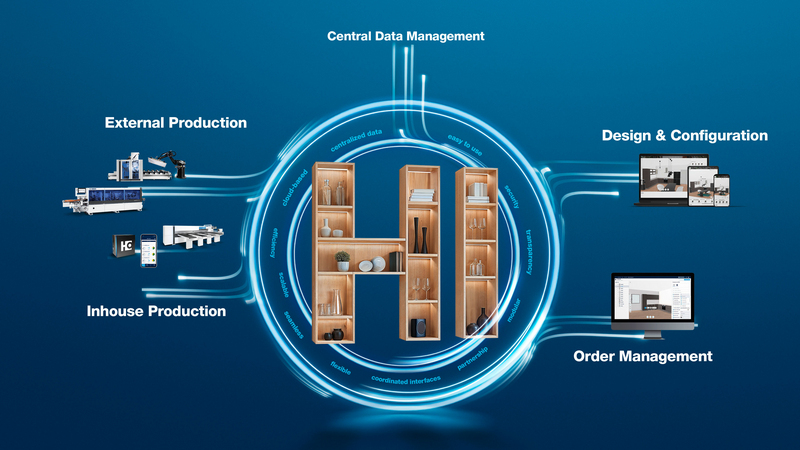
Alexander Lindner: We deliberately describe ourselves as a platform because we want to put into practice precisely the characteristics associated with that term. In concrete terms, this means that we bring together digital modules for sales, configuration and production on a shared, cloud-based foundation. Modularity was extremely important to us from the very beginning of development. Customers should be able to assemble their solution exactly as they need it for their business. A key aspect of this is centralized data management. When a customer adds a new module, it immediately benefits from the data already stored centrally. A classic example is material data: as soon as a new module is activated, all materials stored on the platform are immediately available to it. Internally, we like to compare this with Microsoft 365. Everyone knows this ecosystem: most people use Excel and Word, while some also use SharePoint or OneDrive. You simply select the modules you need. And just like Microsoft, our platform is also completely open on the machine side through interfaces.
“The customer does not have to open up their ERP system to us. We simply connect to it.” – Uwe Jonas
möbelfertigung: You have been offering and developing digital tools for many years. Looking specifically at HOMAG INTELLIGENCE, which lessons from the past have you incorporated, and what is fundamentally new?
Uwe Jonas: Years ago, we started with individual Apps used directly in the workshop. But a workshop is completely different from a private environment: an employee at a machine needs to keep both hands free. One important lesson for us was therefore that scanners and printers must be integrated seamlessly and that information must be displayed appropriately on different media. Using an app in production has to be absolutely frictionless. We also had to learn how such apps perform in demanding commercial use in terms of availability, performance and update capability. We incorporated all of these usability lessons into HOMAG INTELLIGENCE. The decisive step was to integrate the formerly isolated apps into a shared platform, turning them into a genuine end-to-end solution. Today, when an employee scans a component, its status is reported back immediately, updated in the system and made available to the next workstation without delay. Because we had the platform concept in mind from the outset, we never designed the apps to store their data only locally.
möbelfertigung: You mentioned usability. Does that mean making things as simple as possible?
Uwe Jonas: Exactly, as simple as possible. You have to remember that production environments are often hectic. When cycle times are tight, nobody has time to navigate complicated menus on small displays. The employee is carrying the material with both hands. The usability requirements for an app in the workshop are fundamentally different from those of an app you use in a relaxed setting on your iPhone in the evening.
möbelfertigung: Data maintenance is a major challenge throughout the industry. Until now, furniture manufacturers have often had to create laboriously customized interfaces to transfer data from one software system to another. This involves enormous manual effort, high costs and potential sources of error. How does HOMAG INTELLIGENCE solve this interface problem?
Uwe Jonas: The main difficulty with interfaces arises because almost every system stores its own data in its own proprietary format. Our approach is different. When we provide interfaces, for example to material manufacturers, we transfer the data directly into our central data format. This central format is then used throughout the entire process. We therefore do not have a separate interface for every individual function, but one central interface for data management. Let us take materials again as an example. A material is used throughout the entire process, starting with graphical configuration at the point of sale. With a conventional, separate approach, the texture has to be created in the point-of-sale system and the material referenced there. In our system, this information is stored directly in the central material record. When a material is created, it immediately includes the texture, decor code, thickness, dimensions and all production-relevant properties. The material is created only once and then used throughout the entire process. This becomes even more compelling when we consider more complex structures, such as relationship knowledge and design rules for furniture. In most companies, these are handled differently across multiple systems: one logic is used for sales configuration, another for work preparation and another for production data. We have stored this logic and relationship knowledge centrally and developed functionality that remains identical throughout the process. This creates genuine end-to-end integration because the underlying data is always the same. If a material changes in the manufacturer’s catalog, we update it once digitally in our central format, and it is immediately current for everyone involved across the entire process. We completely relieve manufacturers and processors of this interface challenge.
Alexander Lindner: This guarantees companies permanently up-to-date data at all times. It is a major issue because most customers may still manage the initial data setup. But as soon as a catalog changes or new materials are added, the process often breaks down because the changes would have to be maintained manually in ten different places.
“A platform solution pays for itself extremely quickly.” – Alexander Lindner
möbelfertigung: Let us take the example of a cabinetmaker offering customized kitchens. Can they use your construction libraries to create a complete product catalog? And are there already benchmarks showing how much time and money can be saved?
Alexander Lindner: First, an important distinction: in our context, we generally speak of construction libraries, not finished article or design catalogs. We do not supply finished furniture. Instead, we provide a library containing all the construction principles and logical rules needed to create individual articles. One specific example: within just two minutes, a customer can assemble a tall cabinet with an integrated appliance and two drawers. The underlying logic, meaning how the system must respond when the appliance is replaced by a different model, is supplied directly by the library. We have already thought through all of these rules in full. Naturally, customers can extend this foundation individually. We do not want every cabinetmaker to end up building exactly the same cabinets. Everyone should be able to manufacture their own individual product, while the construction logic and foundation come from us. And the best part is that everything remains fully updateable. We treat these libraries like software that we continuously develop. Because they are cloud-based, customers always have access to the latest version. We respond to market changes and provide updates, while customers retain their individual adaptations and special features. This dramatically accelerates the creation of their own designs and articles.
“We completely relieve processors of the interface challenge.” – Uwe Jonas
möbelfertigung: Many companies understandably have concerns about the security of their data. How much does a company have to open up for HOMAG INTELLIGENCE to work? Where is the data stored, and who can access it?
Uwe Jonas: The most important point first: every customer has their own fully protected data area, which only they can access. The data is not accessible to anyone else. When it comes to opening systems, we need to differentiate. In theory, our approach is end-to-end, from sales configuration directly to the machine. In practice, however, there are many parallel processes, such as purchasing or the planning of intermediate-stock parts in the ERP system. As a platform, we do not need to know these details. If a cabinet side has certain dimensions and the company produces it for intermediate stock or orders it externally, the planning procedures, minimum quantities and supplier data remain in the customer’s ERP system. We connect to the ERP through an interface and simply report the specific requirement. The ERP system then handles the process independently in its familiar environment. The customer therefore does not have to open their ERP system to us completely.
möbelfertigung: Does that mean the traditional concerns about data security and system integrity are unfounded?
Uwe Jonas: From our perspective, yes. These concerns usually arise when providers try to sell closed, monolithic systems. We deliberately offer an open solution. We connect existing ERP systems as well as third-party CAD/CAM solutions. The system is designed to be open from the ground up, allowing customers to integrate their existing software landscape without difficulty.
Alexander Lindner: System security is our highest priority. Data is provided only in an agreed and needs-based manner. Together with the customer, we define the optimal distribution of functions within their system landscape in order to create a secure, seamlessly integrated solution with maximum benefit. At no point do we intervene without consent or forcibly extract data from customer systems. Together, we determine what the customer’s system landscape requires and provide the data accordingly and precisely.
möbelfertigung: Your platform is aimed at companies of every size, from industrial furniture manufacturers with hundreds of employees to small joinery businesses with five employees. How does entry into the platform differ between these worlds?
Alexander Lindner: Among cabinetmakers and joiners, we still often see many isolated solutions and the resulting data redundancies. When these businesses move onto our platform, the objective is usually a targeted expansion of functionality. For example, they want to bring data into the workshop digitally, combine orders flexibly and move them cleanly through production with full process control, providing transparency that their existing software often cannot deliver. At the same time, we reduce redundancies, for example by standardizing material data. Entry is therefore highly practical and function-driven. In industry, by contrast, we usually integrate into an existing, highly complex system landscape. The data is generally already available there, but it is often still prepared and distributed manually.
“If a module is no longer needed, the customer can simply cancel it.” – Alexander Lindner
Our task in these environments is to increase the level of automation substantially. This involves complex processes such as automated part identification for stock and finished parts. The creation and provision of master data for a wide range of applications across the group also represents enormous leverage in industrial companies. With these large customers, we sit down together and often rethink the entire process from the ground up based on our platform approach.
möbelfertigung: You also emphasize that HOMAG INTELLIGENCE can provide a flexible foundation for entirely new business models. Which new models do you expect to emerge in concrete terms?
Uwe Jonas: A major topic at present is entry into direct sales or online sales in the B2C market. Many companies have wanted to pursue this for a long time but struggled with implementation. Until now, an online configuration usually had to be entered again completely by hand before it could be manufactured. With us, the configuration logic in the web shop is identical to the logic used internally for production. This makes the path to online business extremely straightforward. Many customers use this to extend their reach beyond regional boundaries.
möbelfertigung: Staying with B2C: is there really such strong demand for this in Germany? The local industry associations are unlikely to be enthusiastic about manufacturers engaging in direct sales.
Uwe Jonas: I cannot assess the associations’ position on this. In general, however, a trend toward a stronger online presence is clearly visible, and more manufacturers are moving into the B2B sector. The main challenges are less about the associations and more about logistics. At the same time, this model is an excellent vehicle for international expansion. Online platforms make it possible to build reach abroad very quickly and directly.
Alexander Lindner: And this approach works for companies of every size. We are not talking only about large industrial manufacturers. Many medium-sized companies that do not sell through the major furniture retailers already offer regional cabinet configurators. They use these digital tools as a teaser to attract customers to their stores in the first place. Our platform standardizes these processes and makes modern sales channels affordable and manageable for smaller businesses as well.
Uwe Jonas: It should not be reduced to B2C alone. If a German manufacturer expands abroad, it can work with local partners who handle sales and installation. These partners then order directly through our platform in a B2B model. The system therefore supports both worlds equally.
möbelfertigung: One particularly exciting aspect of HOMAG INTELLIGENCE is the option of volume-based billing, for example according to the number of parts produced. When can such models be expected in concrete terms, and for whom are they particularly attractive?
Uwe Jonas: We are already using this model in isolated cases during the test phase. It is intended primarily for customers who want to develop a new, higher-risk business area, such as the B2C web shop mentioned earlier. Many companies are initially hesitant about the high upfront investment because they simply do not know whether the new offering will be accepted by the market.
The interview was conducted by Tino Eggert, trade magazine möbelfertigung, issue 3/26