

How an outside perspective helps carpentry businesses to work more economically.
17.11.2026 г.
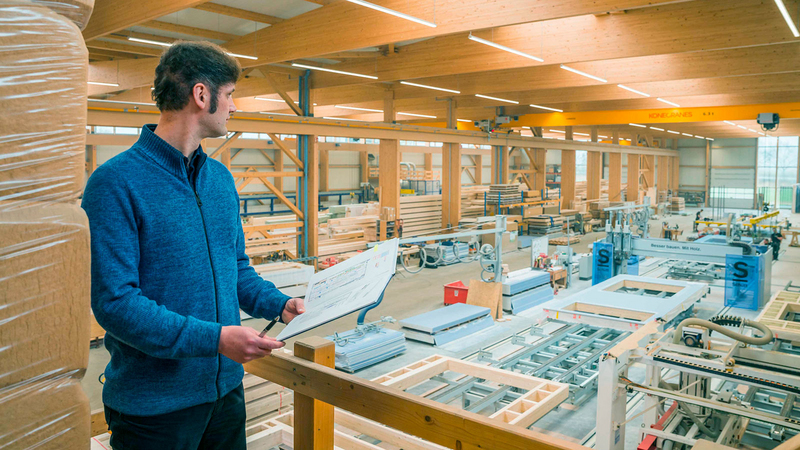
The jobs are in progress, the team know the processes, the machines are producing. Yet the feeling remains: More needs to be done. It's at this point that an outside perspective can help. Florian Hauswirth, Director Consulting at SCHULER Consulting and Christoph Schroth, Manager Global Customer Qualification at WEINMANN have experienced time and again that carpentry firms no longer recognize potential opportunities in everyday tasks. Their consulting approaches start at different points — and can therefore complement each other in a meaningful way.
First clarify: Where is the business is currently — and where does it want to go?
SCHULER considers the business as a whole. The reason for consulting may be the planning of a new production on a greenfield site, but it might equally be the question of how an existing carpentry business can grow or work more economically. "From the beginning, we need to clarify what the customer is doing, what their market looks like and how their production is currently organized," says Hauswirth. The key question then follows: Where does the business want to go? More throughput, more turnover per employee, fewer processes to follow, a different degree of automation? If the goal is clear, the SCHULERteam gets to work.
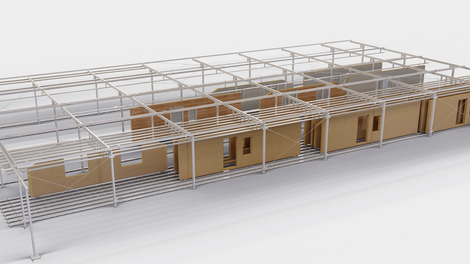
This is where products, production steps, material flow, machine positions, intralogistics, information flow and workstations are taken into consideration. The analysis results in a concept with concrete variants and an economic assessment. The operator of the business therefore sees not only what would be technically possible, but also the effort and costs involved as well as which solution best fits their objectives. If investments are to be made, SCHULER can derive a requirement specification from this analysis. Machine manufacturers are therefore given clear requirements — the company does not have to work out for themselves which technology might be suitable for which process.
Consulting does not have to be a major project
According to Hauswirth, the idea that consulting only makes sense for large manufacturers is a misconception. The outside perspective can be useful even for carpentry businesses with 20 to 30 employees. If you don't want to embark upon a comprehensive project right away, you can start with compact workshops. In these workshops, analysis is carried out to ascertain where improvements can be made in the short term and which issues should be addressed in the longer term, within a fixed time frame and budget. The result is a roadmap with concrete recommendations for action — not a shopping list for new machines right off the bat, but a variety of valuable insights into how to optimize and increase efficiency.
When the machine is working, but the process is no longer suitable
WEINMANNs consulting approach starts later, with existing WEINMANN machines, plants or production lines. Two or three years after installation, the daily operating situation may be different from the situation at the time of installation. For example, new employees may have been added to the workforce, materials may have changed, or there may be new tools on the market more suited to requirements. This is not just about the machine, but also about its environment.
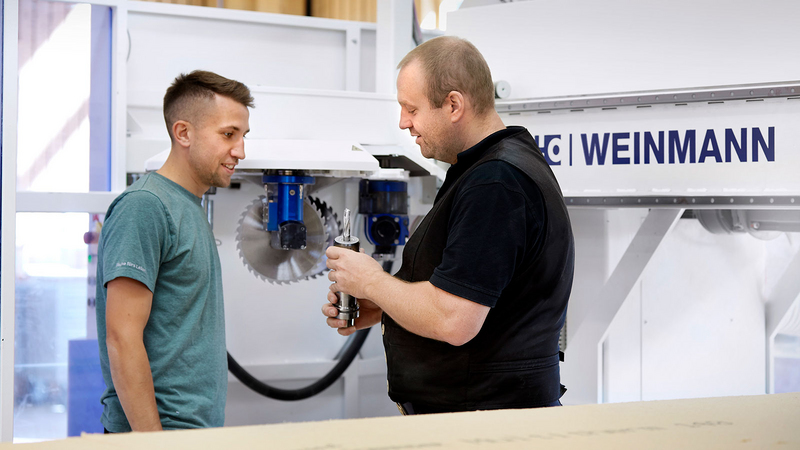
Schroth and his colleagues look at work preparation, tool equipment and parameters as well as material provision, infeed and removal, working processes and employee qualification. A typical example is when partial pallets are stacked on top of each other — meaning that the exact material that is needed regularly ends up at the bottom. Or a material that did not even exist at the time of commissioning is processed with a tool that is not the best choice for this material.
Someone who is in the middle of a process may not see the wood for the trees
Can a business not just recognize such things on its own? "You don't see it," says Christoph Schroth. Not because of a lack of knowledge, but because processes have become entrenched. In addition, there is the daily time pressure. Those who are in the middle of the process rarely have the opportunity to step back. "What's more, an external consultant brings comparisons to many other companies," says Schroth.
Small changes are often all that's needed: a different tool, or five more minutes of attention during work preparation, which will save a lot of time later in production or assembly. Four or five minutes per element initially have little effect — but they add up over many elements and working days. "I'm always bold when I make promises: In fact, I almost always manage to achieve an improvement of ten percent," Schroth says. However, it is crucial that the customer then also implements the recommendations.
SCHULER or WEINMANN?
The two consultations do not replace one another. In particular, SCHULER helps to fundamentally consider the company, its objectives and its production concept and to make investments on a reliable basis. WEINMANN examines how an existing WEINMANN solution can be better used under current conditions. Therefore, for a growing carpentry business, both can be useful: First, determine the direction and later regularly check whether reality still matches the original concept.
The common denominator is simple: Not every improvement requires a new machine. Sometimes all it takes is someone to ask why processes are the way that they are.